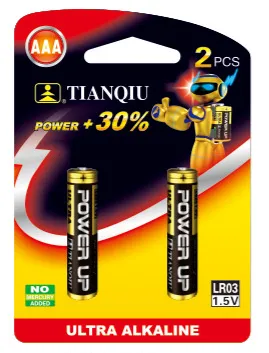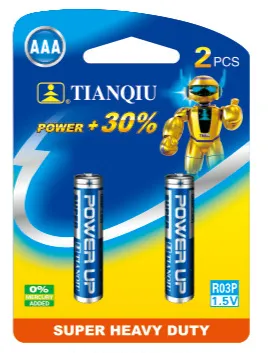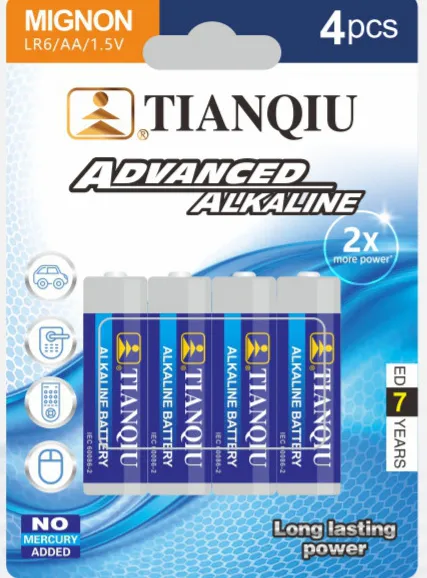
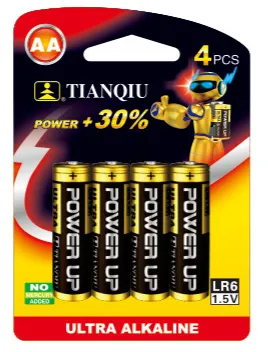
Walk into any supermarket and you will see the same battery chemistry family three ways: carbon zinc on the value shelf, alkaline in the middle, lithium somewhere premium. The chemistry letter on the pack is not decoration — it changes the price, the capacity and the right device.
The three chemistries in one table
| Carbon zinc (R6P) | Alkaline (LR6) | Lithium (CR / L-series) | |
|---|---|---|---|
| Typical AA capacity | 700–1,000 mAh | 1,800–2,900 mAh | up to 3,000 mAh |
| Voltage | 1.5V | 1.5V | 3V (button) / 1.5V (cylindrical) |
| Best for | Clocks, remotes, low drain | Toys, flashes, controllers | Extreme cold, long storage, high-drain electronics |
| Shelf life | 2–3 years | 3–5 years | ~5 years |
| Price per cell | Lowest | Mid | Highest |
Where each one wins
Carbon zinc is the honest budget cell. For a clock, a radio, a remote control — devices that sip current for months — it performs adequately at a fraction of the price. It is the entry tier on every supermarket shelf.
Alkaline carries three to four times the capacity of carbon zinc on a real draw, which is why it is the default for toys, camera flashes and anything with a motor. The caveat: it loses strength under continuous heavy load faster than lithium.
Lithium is the specialist. 3V lithium button cells (CR2032 and friends) deliver double voltage in a compact cell for key fobs and motherboards; cylindrical lithium runs where cold, heat or storage time defeats the others.
The retailer’s shelf strategy
The standard private-label structure we support for supermarket chains is two tiers: carbon zinc for the entry price point, alkaline for the quality position — with lithium button cells as a separate, guarded display (child-resistant packing, mandatory for 3V in EU/US retail).
The chemistry story sells itself: “long lasting power” belongs on the alkaline pack, “0% Hg” on every one of them. See our packaging options →.
The one-rule summary
Match the chemistry to the drain, not the device type: low current → carbon zinc; real work → alkaline; extreme conditions or voltage-compact needs → lithium. Everything else is brand.
Questions behind the article?
The trade team answers technical and commercial questions — send us your market and product interest.
Ask a question